BMW Check Engine Light: Diagnosis in San Diego
BMW Maintenance, Check Engine Light, San Diego Auto Repair
BMW Check Engine Light in San Diego: What It Means and When to Have It Diagnosed
If you drive a BMW in San Diego, you will eventually see the check engine light. Whether it flickers on briefly or stays lit for days, that small amber icon can raise a lot of questions... and a bit of anxiety. Should you pull over immediately? Is it safe to keep driving? Can you just clear the code and hope it goes away? Understanding what your BMW’s check engine light is really telling you is the first step toward protecting your engine, your wallet, and your peace of mind.
Why Your BMW’s Check Engine Light Should Never Be Ignored
The check engine light is your BMW’s way of saying, “Something isn’t right.” It is part of the onboard diagnostic system (OBD) that constantly monitors performance, emissions, and many of the electronic controls that keep your engine running smoothly. When something falls outside of an acceptable range, the system stores a fault code and illuminates the light on your dashboard.
Ignoring that warning might seem tempting, especially if the car still seems to drive normally. But problems that trigger the check engine light often get worse over time. What starts as a minor issue—like a small misfire or an air-fuel mixture that is slightly off—can snowball into major damage to expensive components such as the catalytic converter, turbocharger, or even the engine itself if left unaddressed. In a performance-oriented vehicle like a BMW, the margin for error is small; the systems are tightly integrated and highly sensitive to being run outside their design limits for long periods.
There is also a safety aspect. Some faults can affect drivability—reduced power, stalling, rough running, or overheating. If you are commuting from Carmel Valley, navigating La Jolla traffic, or heading up the I-5 from Del Mar, you do not want your BMW to suddenly lose power or overheat on the freeway. The check engine light is an early warning that gives you the chance to address issues before they put you in a stressful or unsafe situation on the road.
📌 Key Takeaway: If your BMW’s check engine light comes on, it is your cue to schedule a diagnosis—not something to shrug off until “later.”
But Don’t Guess: Why You Shouldn’t Play “Parts Darts” With Your BMW
While ignoring the light is risky, guessing at the cause can be just as costly. Many drivers have heard a friend say, “Oh, it’s probably just the gas cap,” or they plug in a cheap code reader, see a fault description, and immediately start replacing parts. That approach is what professionals sometimes call “parts darts”—throwing parts at the problem and hoping one of them sticks. With a BMW, that is an expensive game to play.
Even if you have a basic handheld scanner or a smartphone app, the information you get is limited. You might see a code that mentions an oxygen sensor, a misfire on a particular cylinder, or an evaporative emissions leak. It is easy to jump to the conclusion that the part mentioned in the code is the one that needs to be replaced. But in reality, the code is describing the symptom, not necessarily the cause. Replacing parts based solely on fault descriptions can lead to:
Unnecessary spending on sensors, coils, or other components that were never actually bad
Persistent check engine lights because the underlying problem was not addressed
Frustration and lost confidence in the car, especially when issues keep returning
BMWs are engineered with complex networks of sensors, control modules, and software strategies. A single fault can have several possible root causes, and those causes are not always obvious without proper testing. That is why guessing or relying solely on generic scan tools is not a smart strategy. Instead, you need a methodical diagnosis that looks beyond the surface and identifies what is really going on under the hood.
💡 Pro Tip: If a shop or friend suggests replacing parts “just to see if it fixes it” without testing or confirming the cause, think twice—especially with a BMW.
One Light, Many Possibilities: What Can Trigger a BMW Check Engine Light
One of the most confusing things about the check engine light is that it always looks the same on the dashboard—yet it can be triggered by a huge range of issues. On a BMW, that same little icon can come on for minor, moderate, or serious problems, including:
Emissions and Air-Management Faults
BMW engines are tightly regulated for emissions. The engine control module monitors how cleanly the engine is burning fuel and whether the exhaust system is doing its job. Faults in components like the evaporative emissions system, secondary air system, or catalytic converters can all trigger the check engine light. Something as simple as a loose or damaged gas cap can cause an evaporative emissions leak code—while a failing catalytic converter can cause similar symptoms but represents a much more serious and costly issue if not addressed in time.
Misfires and Ignition Problems
A misfire occurs when one or more cylinders in the engine are not burning fuel properly. On a BMW, this might be caused by worn spark plugs, failing ignition coils, injector issues, or even mechanical problems like low compression. The check engine light may flash when a severe misfire is detected, indicating that unburned fuel is reaching the catalytic converter and potentially damaging it. Continuing to drive with a flashing light can quickly turn a relatively simple repair into a very expensive one.
Cooling-System Related Faults
Modern BMWs rely on sophisticated cooling systems, including electric water pumps, thermostats, and temperature sensors. If the engine is running too hot, too cold, or the control system detects a problem with coolant flow, it can set a fault and turn on the check engine light. In San Diego’s warm climate—especially if you are climbing grades toward Rancho Santa Fe or sitting in beach traffic in Del Mar—cooling issues can escalate quickly. Addressing these faults early can help prevent overheating, warped cylinder heads, or head gasket failures.
Sensor and Fuel/Air Mixture Issues
Your BMW uses a network of sensors—such as mass airflow sensors, oxygen sensors, manifold pressure sensors, and more—to determine the ideal balance of fuel and air. If any of these sensors are giving readings outside the expected range, the engine control module may compensate as best it can, but it will also store a fault. Sometimes the sensor itself is faulty; other times the sensor is simply reporting a real problem, such as a vacuum leak, intake air leak, or fuel delivery issue. Again, the same code can point to multiple possible causes, which is why proper testing matters so much.
Electrical and Software-Related Problems
BMWs are as much rolling computers as they are mechanical machines. Wiring faults, poor connections, module communication issues, and software glitches can all contribute to check engine lights. A sensor might be functioning correctly, but if the wiring harness has corrosion or a connector is loose, the signal reaching the control module may be intermittent or incorrect. In other cases, BMW may release updated software for certain modules to address known drivability or emissions issues. Without BMW-specific diagnostic tools and up-to-date information, these types of problems are very difficult to track down accurately.
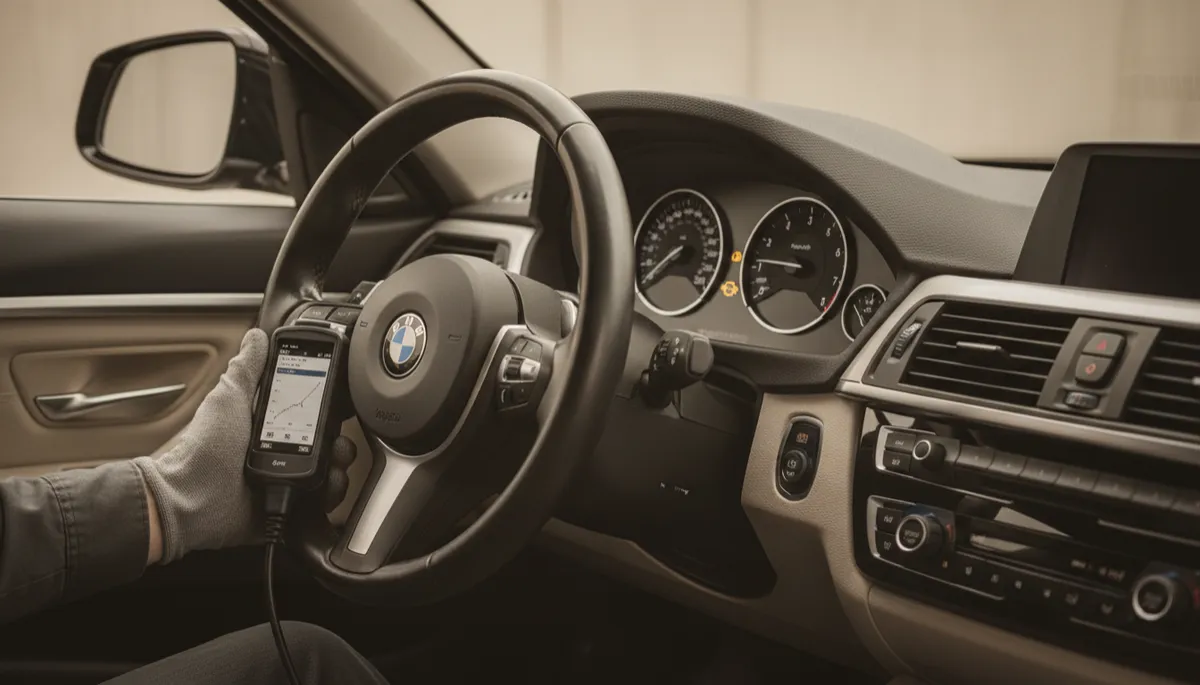
The same BMW check engine light can signal dozens of different underlying issues.
Reading the Fault Code Is Only the Starting Point: Not the Full Answer
When your BMW’s check engine light comes on, the first step is always to read the stored fault codes. This can be done with a scan tool, but the key is understanding what those codes really mean. A fault code is like a chapter title in a book—it tells you the general area of the story, but not the entire plot. It points you toward where the vehicle’s computer has detected a problem, but it does not automatically say, “Replace this exact part.”
For example, a code for an oxygen sensor might indicate that the sensor is reading a mixture that is too rich or too lean. That could be due to a failing sensor, but it could also be caused by a vacuum leak, a fuel pressure problem, a misfire, or even an exhaust leak upstream of the sensor. Replacing the sensor without further testing might temporarily change the readings, but if the underlying issue remains, the light will return—and you will have paid for a part you did not truly need.
Proper diagnosis uses the fault code as a starting point for a logical testing process. It may involve checking live data from multiple sensors, performing smoke tests to find air leaks, measuring fuel pressure, inspecting wiring and connectors, or even conducting mechanical tests like compression or leak-down checks. The goal is to confirm the actual cause of the fault, not just treat the symptom that the code describes. That is where a specialized BMW shop makes a real difference.
📌 Key Takeaway: A code tells you where the car sees a problem. It takes expert testing and inspection to know what actually needs to be repaired.
How Meister Werks Diagnoses BMW Check Engine Lights in San Diego
Meister Werks provides BMW diagnostics and repair in Miramar, serving drivers throughout San Diego, La Jolla, Carmel Valley, Del Mar, Rancho Santa Fe, UTC, and the surrounding areas. When your BMW’s check engine light comes on, their approach is centered on accuracy, transparency, and BMW-specific expertise—never guesswork. Here is how they tackle check engine light concerns from the moment you arrive.
Step 1: Listen to You and Document the Symptoms
Diagnosis starts with communication. The technicians at Meister Werks ask questions about what you have noticed: Did the light come on after refueling? Is it solid or flashing? Have you felt any loss of power, rough idle, hard starting, or unusual noises? Does the issue appear more when the car is cold, hot, or under certain driving conditions—like climbing hills toward Rancho Santa Fe or cruising along the 805? These details help frame the problem and guide the initial testing strategy.
Step 2: Connect BMW-Specific Diagnostic Equipment
Instead of relying on generic code readers, Meister Werks uses BMW-specific diagnostic equipment designed to communicate with your vehicle’s systems at a deeper level. These tools can access not just basic OBD codes, but also BMW manufacturer-specific fault codes, freeze-frame data, module communication information, and live sensor readings. This level of access is crucial for understanding how different systems are interacting when the fault occurs, and it provides data that generic tools simply cannot see.
Step 3: Analyze Codes, Data, and Patterns—Not Just “What Part Is Mentioned”
Once the BMW diagnostic system has been scanned, the technicians review all stored and pending codes, as well as the conditions under which they were set. They look for patterns—multiple codes pointing toward a common system, intermittent versus constant faults, or data that suggests a sensor is reporting accurately but something upstream is wrong. This analysis helps them decide what tests to run next rather than jumping straight to replacement recommendations.
Step 4: Perform Targeted Testing to Confirm the Root Cause
With a working theory in place, Meister Werks moves on to hands-on testing. Depending on the nature of the fault, this may include:
Smoke testing the intake or evaporative emissions system to locate air or vapor leaks that could affect fuel mixture or trigger emissions codes
Fuel system checks, such as verifying fuel pressure and injector performance if mixture or misfire codes are present
Ignition system testing, including coil and spark plug inspection, to pinpoint the source of misfires rather than replacing all coils blindly
Cooling system evaluation, checking the operation of electric water pumps, thermostats, and temperature sensors when cooling-related faults are stored
Electrical and wiring inspection, verifying power, ground, and signal integrity at sensors and modules when communication or intermittent faults are suspected
This testing phase is where true diagnosis happens. Instead of assuming that a part is bad because its name appears in a code description, the technicians at Meister Werks confirm whether that part is actually failing or whether it is responding to another problem somewhere else in the system.
Step 5: Hands-On Inspection and Real-World Road Testing
Computers and scan tools are powerful, but they do not replace an experienced eye and ear. Meister Werks incorporates hands-on inspection of hoses, connectors, wiring harnesses, fluid condition, and any visible signs of wear or leaks. When appropriate, they also perform road tests to reproduce symptoms under real driving conditions, whether that is stop-and-go city traffic in UTC or highway cruising between San Diego and La Jolla. This combination of data and real-world observation helps ensure that the diagnosis matches how the car behaves in your daily life, not just in the service bay.
Step 6: Clear, Honest Explanations Before Any Repair Is Recommended
Once the root cause has been identified, Meister Werks explains their findings in straightforward language. They will review which codes were stored, what testing was performed, what was discovered, and which repair options are available. If there are multiple issues—some urgent and some more maintenance-oriented—they can help you prioritize based on safety, reliability, and your budget. The focus is on giving you accurate information so you can make an informed decision, not pressuring you into unnecessary work.
💡 Pro Tip: A good BMW specialist will show you test results and explain why a part needs to be replaced, not just tell you that it does.
Why BMW-Specific Tools and Experience Matter So Much
While any shop can buy a basic code reader, BMWs require a higher level of tooling and knowledge to diagnose accurately. BMW-specific diagnostic platforms can access control modules, adaptations, live data streams, and service functions that generic tools simply cannot reach. This allows technicians to:
See BMW manufacturer-specific codes and descriptions that provide more precise information than generic OBD codes
Run system tests and activations—such as operating pumps, valves, and fans—to verify proper operation during diagnosis
Check software versions and, when appropriate, identify if software updates are recommended for certain modules
Just as important as the tools is the experience behind them. A shop that regularly works on BMWs—like Meister Werks in Miramar—builds a deep familiarity with common patterns, known problem areas, and model-specific quirks. They know, for example, which engines are prone to certain sensor failures, which models often develop intake leaks, and how Southern California’s climate and driving conditions affect wear. That context speeds up diagnosis and helps avoid chasing the wrong problem.
When Should You Schedule a BMW Check Engine Light Diagnosis?
Not every check engine light means you need to pull over immediately, but you also do not want to wait until the car leaves you stranded. As a BMW owner in the San Diego area, here are some practical guidelines to follow:
Flashing check engine light: This usually indicates an active, serious misfire that can damage the catalytic converter. Reduce speed, avoid heavy acceleration, and have the car diagnosed as soon as possible. If the car is running very rough, it may be safer to arrange a tow to a shop like Meister Werks rather than continue driving.
Solid check engine light with noticeable symptoms: If the light is on and you feel reduced power, rough running, hesitation, or poor fuel economy, schedule a diagnosis promptly. Continuing to drive may worsen the issue or cause additional damage over time.
Solid check engine light with no obvious symptoms: It may be safe to drive short distances, but you should still have the car checked in the near future. Many emissions and mixture issues are subtle at first yet can still harm expensive components if ignored.
In all cases, the safest and most cost-effective approach is to treat the check engine light as a request for attention—not a suggestion you can postpone indefinitely. A timely visit to a BMW specialist like Meister Werks can turn a potential major repair into a manageable, well-planned service.
Serving BMW Drivers Across San Diego, La Jolla, Carmel Valley, Del Mar, Rancho Santa Fe, UTC, and Beyond
Located in Miramar, Meister Werks is conveniently positioned for BMW owners throughout the greater San Diego area. Whether you live in La Jolla, commute from Carmel Valley, spend weekends in Del Mar, or drive in from Rancho Santa Fe or UTC, their shop offers a central, accessible location for professional BMW diagnostics and repair. Rather than rolling the dice with a general repair shop or trying to guess at the cause yourself, you can bring your BMW to a team that understands these cars inside and out and has the tools to diagnose them properly.
Their focus is not just on turning off the check engine light, but on restoring your BMW’s performance, reliability, and efficiency. That means identifying the real cause of the fault, confirming it with proper testing, and recommending repairs that make sense for you and your vehicle—not just replacing parts until the light happens to stay off.
Putting It All Together: Smart, Informed Care for Your BMW
Your BMW is a sophisticated, finely tuned machine designed to deliver a driving experience that is both engaging and refined. The check engine light is part of that sophistication—a built-in system that alerts you when something needs attention long before it becomes catastrophic. The key is how you respond when that light comes on. Ignoring it risks long-term damage and higher repair bills. Guessing at the cause or throwing parts at the problem wastes money and rarely solves the issue for good.
Instead, treat the check engine light as a prompt to get clear, accurate answers. Remember that:
The same light can be triggered by emissions faults, misfires, cooling problems, sensor or fuel/air mixture issues, and electrical or software-related faults.
Reading the fault code is only the starting point; it tells you where the vehicle sees a problem, not exactly which part to replace.
Proper diagnosis relies on BMW-specific diagnostic equipment, methodical testing, and hands-on inspection from technicians who understand these cars.
Meister Werks in Miramar brings all of these elements together for BMW drivers across San Diego, La Jolla, Carmel Valley, Del Mar, Rancho Santa Fe, UTC, and nearby communities. When your check engine light appears, they do not treat it as a guessing game or a quick code-clear. Instead, they approach your car with the same care and precision that went into engineering it—so you can get back to enjoying the drive with confidence that the problem has been correctly diagnosed and properly repaired.
The next time that amber light appears on your BMW’s dashboard, resist the urge to ignore it or search for a one-size-fits-all answer online. Schedule a professional diagnosis with a BMW specialist who will look beyond the code, uncover the real cause, and help you make the best decision for your vehicle. Your engine, your budget, and your peace of mind will all be better for it.